A white T-shirt tucked into tailored trousers, white trainers, no pattern: the outfit works, but it says nothing. You see it ten times a day on the subway or in an open-plan office.
Adding just one visible piece of jewellery—a chunky-link bracelet or a short necklace—is enough to create a focal point that draws the eye. The question isn’t whether jewellery can add character to a simple outfit, but which piece to choose for a clear effect without going overboard.
Which jewellery to choose for a monochrome outfit
With a tonal outfit (black, navy, grey, beige), jewellery takes the place of pattern or colour. The contrast then comes entirely from the piece’s texture, volume and finish.
A wide brushed-metal bracelet on a bare wrist, peeking out from a rolled-up sleeve, catches the light without trying too hard. That’s exactly the idea behind the anchor bracelet that transforms an outfit: a piece that draws its strength from a distinctive motif rather than sheer shine.
With a monochrome outfit, one textured piece of jewellery makes more of an impact than a coordinated set. A choker with a black crew neck, for example, works because it breaks up the neckline’s horizontal line. Two layered necklaces over the same neckline, on the other hand, muddy the focal point.
As a rule of thumb, the plainer and more pared-back the outfit, the more texture the jewellery can have (twisted links, a cabochon, a bold geometric shape). The reverse is also true: with a busy print, a slim ring works better than a statement necklace.

Necklace, bracelet or earrings: where to place the accent
Choosing where to wear a piece of jewellery radically changes the impression it makes. It’s not an abstract matter of taste, but a practical consideration shaped by the neckline, sleeves and hairstyle.
Open neckline: the necklace’s territory
A V-neck or boat neck leaves skin exposed. A short necklace fills the space without competing with the garment. Fine layered chains work well here because there’s plenty of skin on show. With a roll neck, a necklace disappears or creates an awkward bulge beneath the knit: it’s better to choose another type of jewellery.
Short or rolled-up sleeves: the bracelet’s territory
When your forearms are bare, a bracelet or a chunky watch naturally draws the eye. Thick-link bracelets, open bangles and styles with decorative clasps add character to a simple T-shirt. Avoid wearing a bracelet and a statement watch on the same wrist unless you’re deliberately going for a more-is-more look.
Hair tied back: earrings take centre stage
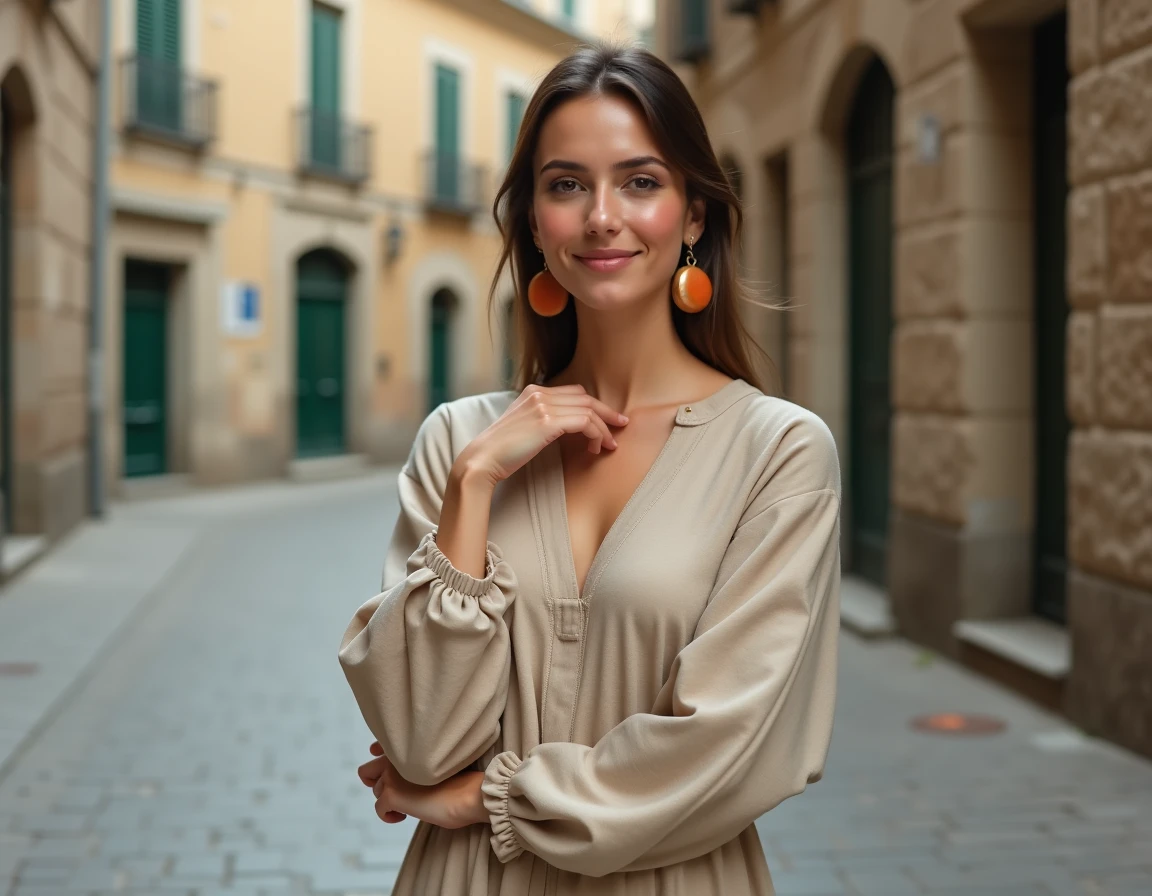
A bun or ponytail leaves the earlobes and jawline exposed. Drop earrings frame the face when your hair is pulled back. With thick, loose hair, drop earrings can get lost in the volume; larger studs or short hoops are easier to see.
Metal, material and comfort: the factors we overlook
Visual appeal gets most of the attention, but comfort determines whether you’ll actually wear a piece day to day—and whether it will get the chance to transform anything.
- The European REACH regulation limits the release of nickel from items in prolonged contact with the skin. If you’re prone to irritation or itching after wearing jewellery for a few hours, ask about the alloy’s composition before buying.
- Weight matters over time. A dramatic statement necklace might be perfect for an evening out but become uncomfortable after four hours at the office. For everyday wear, gold-plated brass and silver pieces are lightweight while still making a visual impact.
- The finish (polished, brushed, satin or hammered) changes how the metal reflects light. A brushed finish looks more understated than a mirror finish, even at the same size. For a simple work outfit, brushed metal adds character without an overpowering shine.
A piece’s effect also depends on the ambient light. A highly polished gold piece that works well in daylight can feel too prominent under office lighting. This makes it difficult to set a universal rule for choosing between gold, silver and rose gold: the right choice depends as much on the lighting as on your skin tone.
Vintage or new jewellery: where character comes from
An Art Deco brooch found at a flea market and pinned to the lapel of a plain blazer tells a story that a piece straight out of its packaging can’t replicate. Here, the character comes from the piece’s uniqueness, its slight wear and its contrast with the rest of the outfit.
Vintage jewellery adds character through its stylistic contrast with contemporary clothing. A patinated signet ring on a hand that’s also wearing a modern jersey jacket creates a visual dialogue that two pieces from the same collection can’t.
One caveat: a hallmark on vintage jewellery indicates the metal’s fineness and identifies a responsible party, but it doesn’t tell you the piece’s actual condition or the quality of any stones. In the second-hand market, a hallmark is no substitute for a full appraisal. Before investing in a vintage piece intended to become a wardrobe signature, having a professional check its condition is a basic precaution.
Signature jewellery: building a recognisable style
Wearing the same piece every day, whatever the outfit, turns it into a personal signature. A wide ring on your index finger, a short chain you never take off, a pair of hoops worn from Monday to Sunday: repetition creates identity.
Signature jewellery works because it becomes inseparable from the person wearing it. You may stop noticing it on its own, but you notice when it’s missing. With simple outfits that don’t vary much (a shirt, trousers, a jacket), this visual constant creates a sense of cohesion without any effort to coordinate.
The trap is choosing a piece that’s so on-trend it looks dated after a season. Simple geometric shapes, plain metals without stones and classic links stand the test of time. An anchor-motif bracelet, an open bangle, a cable chain: these styles have been around for decades and aren’t tied to any particular era.
A simple outfit isn’t automatically lacking in character. It just needs a focal point. A well-placed piece of jewellery, suited to the neckline, comfortable to wear and worn consistently, does the job without requiring you to rethink your entire wardrobe.