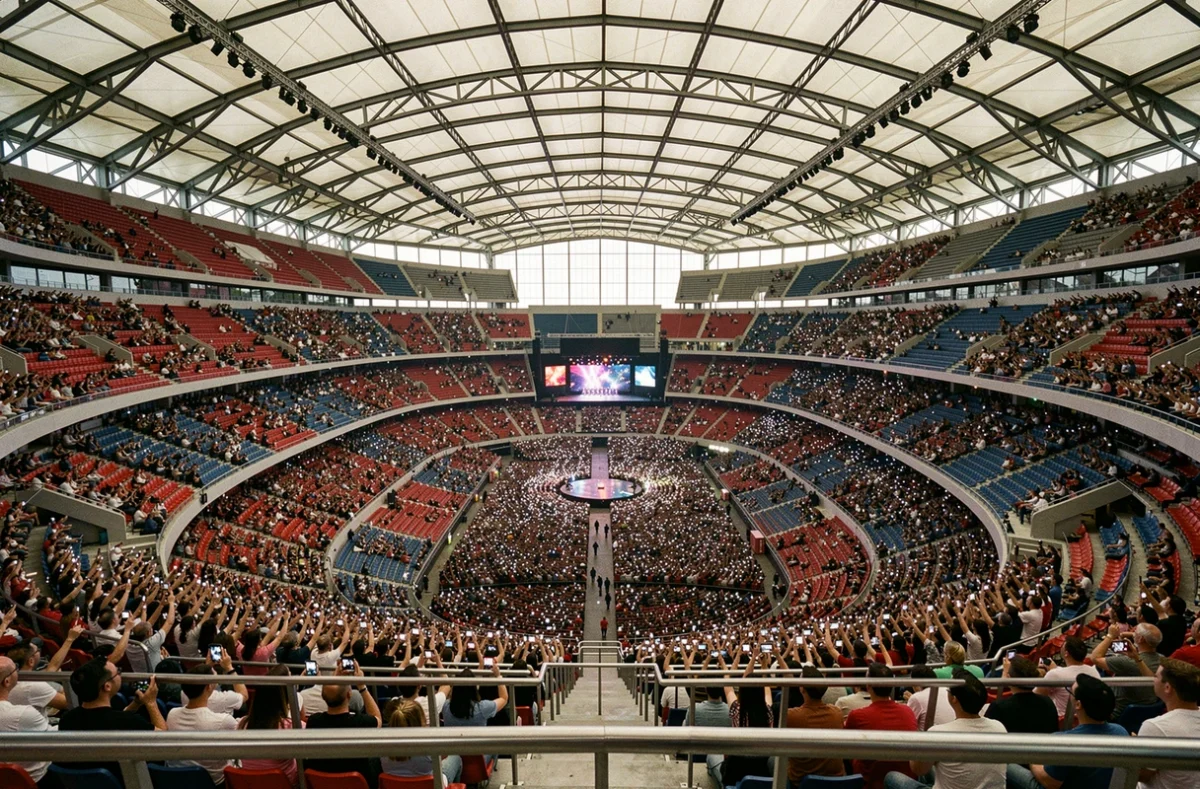
The announced capacity of 80,000 seats at the Stade de France does not correspond to the number of tickets available for a concert. Between the stage, technical areas, security barriers, and premium zones, the actual capacity sold varies from one event to another. Understanding how the categories of seats are distributed allows for anticipating what each ticket offers in terms of proximity, comfort, and visibility.
Actual capacity of a concert at the Stade de France: what the capacity does not reveal
The figure of 80,000 seats refers to the maximum capacity of the stadium in a sports configuration. During a concert, several factors reduce this total. The stage itself occupies part of the stands and the field, removing hundreds of seats. Technical areas (sound control, lighting control, wiring walkways) neutralize other zones.
Security measures also play a direct role. Anti-crush barriers segment the pit into smaller blocks, each block having a capped capacity. Regulatory evacuation routes require clear corridors through the stands. Ultimately, the actual capacity available must be verified on the ticket sales plan for the specific concert, and not deduced from the stadium’s overall capacity.
The gap between the theoretical capacity and the number of tickets sold explains why some concerts are sold out while others, with a more compact staging, offer more seats. There is no single figure: the stage configuration is decided by the artist and their producer, making each seating plan unique.
To delve deeper into the question of capacity and categories of seats at the Stade de France concert, it is important to distinguish between the field areas and the stands, as their access rules and pricing follow different logics.

Categories of seats at a concert: comparative table of typical zones
The categories are not universal from one concert to another. The organizer of each event validates the prices and associated sectors. A “category 1” may refer to a block of lower side stands for one artist and a corner for another. The table below summarizes the zones most frequently found in concert seating plans at the Stade de France.
| Zone | Position | Placement | Main characteristic |
|---|---|---|---|
| General pit | Field, facing the stage | Standing, free | Maximum proximity to the stage |
| Golden pit / Golden circle | Field, front area | Standing, free | Restricted area closer to the stage than the general pit |
| Golden square | Field, defined zone | Standing or seated depending on configuration | Premium access, reduced density |
| Seated field / Numbered floor | Back field | Seated, assigned seat | Guaranteed seat, clear view of the stage |
| Lower stand | First ring | Seated, numbered seat | Good compromise between proximity and comfort |
| Intermediate stand | Second ring | Seated, numbered seat | Panoramic view of the staging |
| Upper stand | Third ring | Seated, numbered seat | Generally the most affordable price |
This breakdown remains indicative. The field can be divided into two, three, or four sub-zones depending on the size of the stage and production choices. The categories are approved by the organizer of each event, which means that the same physical sector of the stadium can change its name and price from one concert to another.
Pit, golden field, and golden square: concrete differences between standing zones
The distinction between the general pit, golden pit, and golden square regularly generates confusion. All three zones are located on the field, but their perimeter, density, and price differ.
- The general pit occupies the largest area of the field. Placement is free, and the audience density is high, especially in the front rows. The back rows offer more space and easier access to concessions.
- The golden pit or golden circle is a more restricted perimeter, located closest to the stage. It guarantees superior proximity but remains standing and free placement, without assigned seating.
- The golden square acts as a buffer zone between the golden pit and the stands. Depending on configurations, it may offer seats or remain standing, with a deliberately reduced density for more comfort.
None of these zones guarantees a specific location. Arriving early directly influences the position obtained. In contrast, the seated stands offer an assigned seat, eliminating this variable.

Accessibility and specific arrangements at the Stade de France for concerts
The accessibility offer at the Stade de France extends beyond wheelchair locations. For certain concerts, a Sensory Room is offered for free, with a dedicated stand for individuals with sensory sensitivities. This facility allows for following the show in a muted environment in terms of sound volume and light stimulation.
However, this Sensory Room does not provide a direct view of the arena. The corresponding seats are also not suitable for individuals with reduced mobility, which necessitates distinguishing between two reservation processes based on need. Access conditions (opening hours, dedicated lines, authorized companions) can also modify the practical experience of a ticket category compared to what it promises on paper.
Check the seating plan before purchasing a concert ticket
Why the seating plan changes from concert to concert
The staging drives everything. An artist performing on a central stage (like a T-shaped walkway) frees up stands that are normally hidden by a frontal stage. Conversely, a monumental stage with giant side screens can neutralize entire sections of the first ring.
A well-placed category 2 can offer a better view than an off-center category 1. The numbering of categories reflects a price level, not always an objective ranking of visual quality. Consulting the 3D view provided on the Stade de France website, by entering the section and row number, remains the most reliable way to assess a location before purchase.
The sales plan published at the opening of ticket sales is the only contractual reference. Visual previews or feedback from past concerts provide an indication, but the exact layout of blocks, barriers, and screens can differ significantly from one production to another.