
A blood glucose sensor attached to the arm that sends its data to a mobile app, an algorithm that detects an anomaly on a chest scan before the on-call radiologist: these situations are no longer prototypes. They are becoming part of standard care pathways, both in the city and in hospitals. Technological innovations in health and wellness are progressing rapidly, but their actual adoption depends on constraints that marketing announcements often overlook.
Cybersecurity of medical devices: the barrier that no one budgets for
When deploying a connected device in a hospital department, the first question is no longer “does it work?” but “is it secure?”. Documented trends for 2026 place digital resilience at the same strategic level as artificial intelligence in healthcare facilities.
In practical terms, a patient monitoring sensor that transmits real-time data creates an additional network entry point. Each added connected object multiplies the attack surface. Technical teams must manage data encryption, firmware updates, and access authentication, often with budgets that have not kept pace.
Cybersecurity now conditions the deployment of health innovations, not just their approval. A hospital that installs a telemonitoring solution without prior security auditing exposes itself to service interruptions that directly affect patients. This topic is discussed in detail in recent articles from Geek Medical, where the stakes of digital security are regularly intertwined with medtech innovations.

Medical artificial intelligence: monitoring the model after deployment
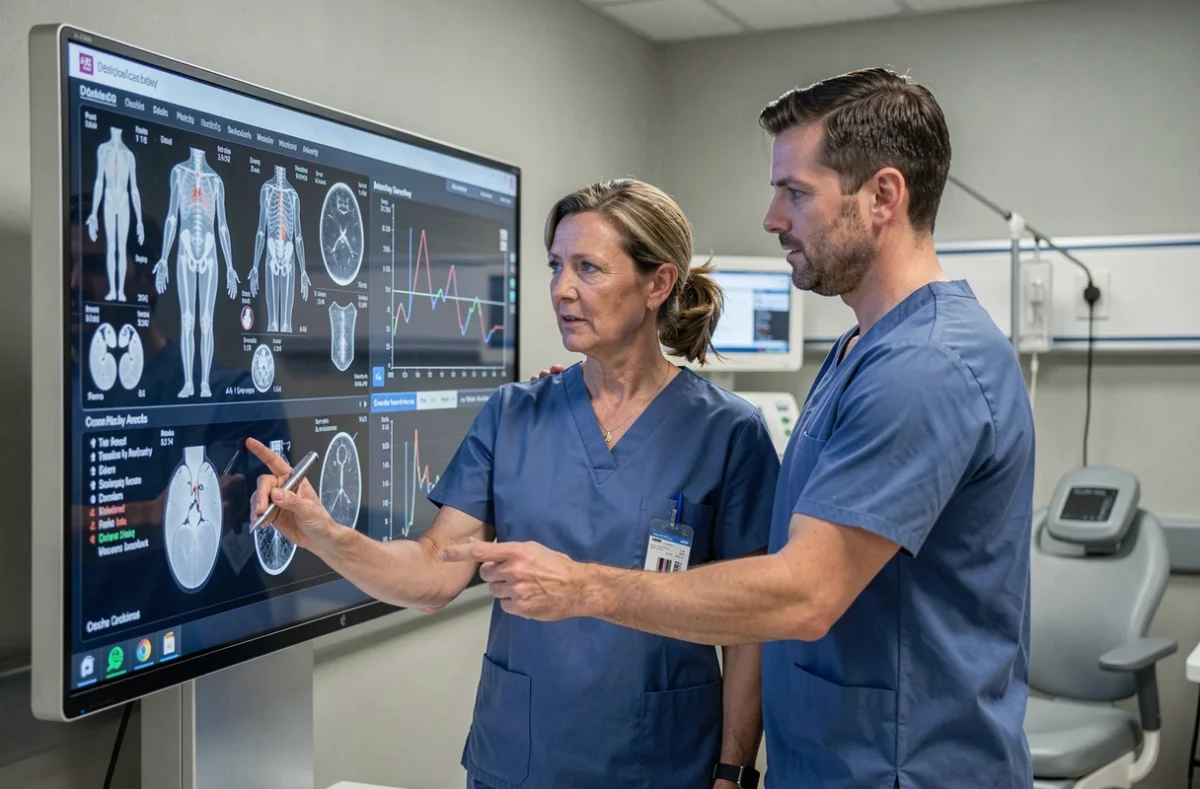
AI in diagnostics is no longer a novelty. What is changing is the awareness that these algorithms must be continuously reevaluated, not just validated once before hitting the market.
The FDA discussed in September 2026 competency-based evaluations and new validation methods specific to medical generative AI. The central issue: models capable of evolving after deployment. A detection algorithm trained on a hospital dataset can drift if the patient population or imaging protocols change.
What this implies on the ground
For a radiologist or a biologist using a diagnostic aid tool, this logic of continuous monitoring means regular software updates and periods of clinical revalidation. During these phases, operations revert to manual mode, or readings are doubled.
Medical AI is shifting from a launch logic to a continuous monitoring logic. Institutions integrating these tools must allocate resources for post-deployment follow-up: data engineers, reevaluation protocols, version tracking. This is not a technical detail; it is a condition for clinical reliability.
Decentralized clinical trials: testing care outside the hospital
Clinical trials are increasingly moving out of hospital centers. This evolution opens concrete perspectives for testing connected devices and care pathways directly in patients’ real-life conditions.
On the ground, this changes a lot of things. A patient included in a trial for a cardiac monitoring sensor no longer needs to travel weekly to a research center. Data is collected at home, transmitted via an app, and analyzed remotely by the research team.
- Recruitment expands geographically: patients far from university hospitals can participate, improving the representativeness of cohorts
- Data better reflects the patient’s daily life (physical activity, sleep, actual adherence) compared to a controlled hospital setting
- Logistical constraints decrease for participants, reducing dropouts during the study
Feedback varies on this point depending on the pathologies and patient profiles, but the underlying trend is clear: clinical research in France is seeking to adapt to the real conditions of use of innovations.
Connected wellness devices: the limits of constant measurement
Watches, rings, sleep bands: the wellness wearables market continues to expand. Heart rate, rhythm variability, oxygen saturation, sleep quality are measured. But the measured data does not always reflect the state felt by the user.
A study reported in 2026 highlighted this gap between physiological measurement, algorithmic interpretation, and subjective experience. In other words, your watch may display an excellent sleep score while you feel exhausted, or vice versa.
The issue of abandonment
The other concrete challenge is the abandonment rate. The reasons are multiple:
- Fatigue from notifications and daily scores that end up generating anxiety rather than motivation
- Lack of medical context: without interpretation by a healthcare professional, raw data loses its usefulness
- Perceived inaccuracy on certain parameters (deep sleep, stress) that erodes trust in the device
A useful connected object is one whose data is reviewed by a caregiver. Without this feedback loop, we accumulate numbers without producing health decisions.
Digital governance in health: the French reorganization
On the institutional management side, the French public governance of digital health has recently been reorganized. This evolution does not directly concern the patient, but it conditions the speed at which digital innovations are deployed in the healthcare system.
The interoperability of health information systems is at the heart of this reorganization. A patient record that does not communicate with the prescription software or the telemonitoring device creates breaks in the care pathway. The new administrative architecture aims precisely to resolve these technical blockages that slow down the adoption of digital tools.
Personalized medicine, connected devices, and medical artificial intelligence will only produce their effects under one condition: that the technical, regulatory, and human infrastructure keeps pace with announcements. A high-performing algorithm in a poorly protected hospital, a wearable abandoned at the back of a drawer, or a clinical trial that does not recruit outside major cities are all innovations that remain at the stage of promise. The next step is not technological; it is organizational.