
In France, organizing a wedding involves coordinating two distinct realities: a legal act governed by the Civil Code and a celebration whose contours depend entirely on the couple’s choices. The civil ceremony, the only legally recognized union, must precede any religious or secular celebration. This legal framework structures the timeline well before questions of decoration or menu arise.
Administrative wedding file: deadlines that no one really masters
Most wedding preparation guides start with the budget or the reception venue. The administrative file often comes last on the list, even though it determines the date itself. The town hall requires a set of documents: birth certificates issued within the last three months, proof of residence, and information about the witnesses.
For binational couples, the situation becomes more complicated. Foreign civil status documents require a sworn translation and sometimes legalization or an apostille. These processes can take several weeks or even months depending on the country of origin. Practical feedback, especially for ceremonies in Paris, describes these formalities as particularly lengthy.
One often overlooked point: the wedding can be celebrated in the municipality of residence of one of the parents of the future spouses, not just in their own municipality. This possibility allows for the civil ceremony to be closer to the reception venue or family setting, simplifying the logistics of the day. Platforms like tomymariage.fr allow you to explore suitable service providers for each location once the municipality is chosen.

Wedding budget: balancing fixed and variable costs
The budget remains the factor that shapes all other choices. The reception venue and the caterer generally represent the largest portion of expenses. In contrast, some items like stationery or invitations have seen their costs decrease thanks to digital tools.
Setting a total budget before contacting any service provider avoids the accumulation effect, where each expense taken in isolation seems reasonable but where the total spirals out of control. A practical method is to categorize expenses into three groups:
- Non-negotiable items (venue, caterer, officiant if secular ceremony) that absorb the majority of the budget
- Adjustable items (photographer, florist, musical entertainment) where the price range varies significantly among providers
- Optional items (videographer, photobooth, guest gifts) that can be added or removed without altering the ceremony
Field feedback varies on the relevance of a wedding planner. For large weddings or couples with limited availability, professional coordination alleviates some of the logistical stress. For a more intimate wedding, this expense can be reallocated elsewhere.
Secular ceremony and personalized rituals: what really changes the day
The civil ceremony rarely lasts more than twenty minutes. It is the secular ceremony, when chosen, that offers the widest space for personalization. Unlike a religious ceremony, which follows a codified ritual, the secular ceremony is built entirely to measure.
The officiant can be a friend, a family member, or a professional. The choice directly influences the tone. A close friend knows the couple’s story but may lack the experience to manage the rhythm and collective emotion. A professional officiant masters the staging but will need to get to know the couple.
Symbolic rituals (sand mixing, tree planting, ribbon ceremony) work when they resonate with the couple’s reality. Imposing a ritual found on a blog that has no connection to one’s own experience produces the opposite effect: a hollow moment instead of a powerful one. A ritual chosen out of conviction leaves a stronger impression on guests than a spectacular staging.
Guest list and seating plan: predictable tensions
The guest list is probably the most frequent source of friction in organizing a wedding. It involves the expectations of both families, the venue’s capacity constraints, and the budget per guest for the caterer.
Creating the list in three concentric circles helps to objectify choices: the first circle (immediate family, close friends) forms the non-negotiable base, the second circle (extended family, close colleagues) depends on the remaining budget, and the third circle (acquaintances, social obligations) is only added if capacity allows.
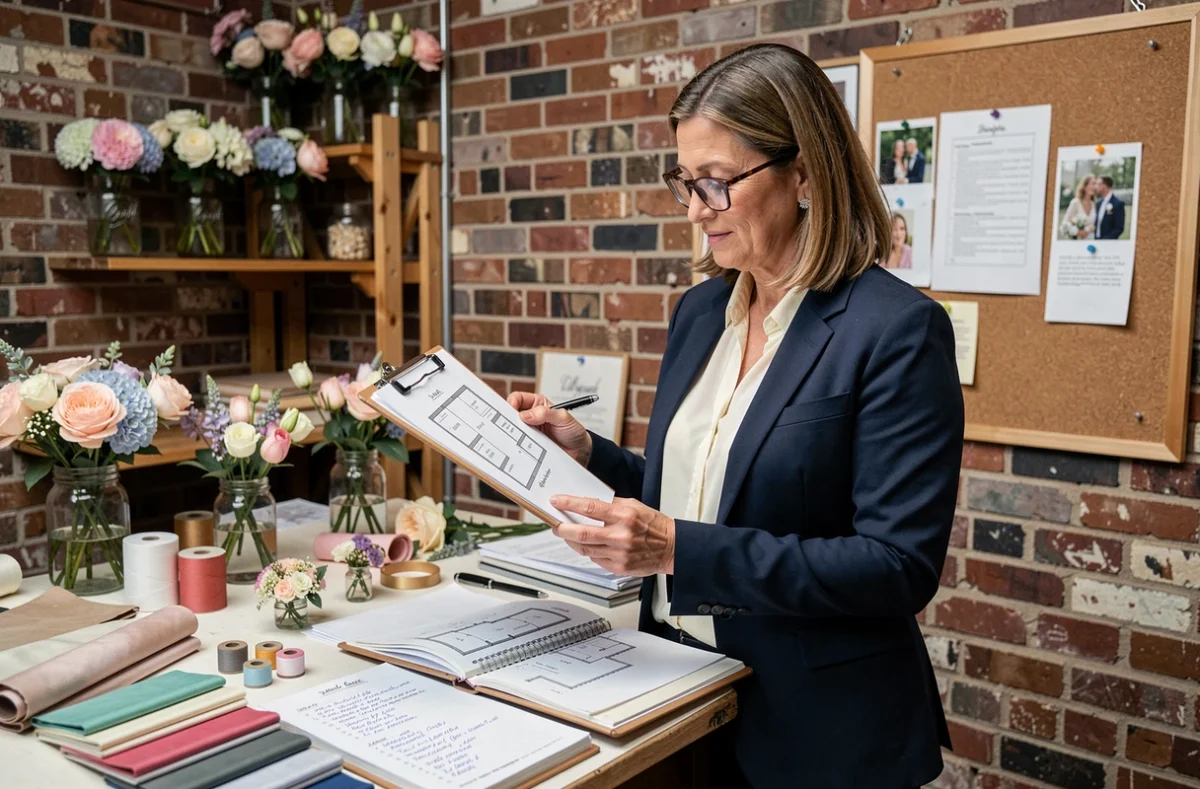
The seating plan, on the other hand, requires cross-referencing several parameters: affinities between guests, sometimes tense family dynamics, and the presence of children or elderly people needing appropriate placement. Starting the seating plan too early is counterproductive since confirmations often arrive late. Waiting for final responses before finalizing the placements avoids having to redo the work three times.
Day-of coordination: what deserves a rehearsal
The flow of the day relies on a sequence of tight time slots. Between the civil ceremony at the town hall, the journey to the reception venue, group photos, the cocktail, and dinner, each transition of more than fifteen minutes creates a noticeable dead time for guests.
- Designate a clearly identified logistics manager (witness, wedding planner, organized friend) who manages the schedule and unforeseen events
- Communicate the detailed schedule to the service providers at least a week in advance, along with the contact information for each participant
- Anticipate a buffer slot of about thirty minutes between the civil ceremony and the following events to absorb delays at the town hall
A rehearsal at the site of the secular ceremony, even a quick one, allows for coordinating entrances, sound setup, and the officiant’s positioning. This often deemed unnecessary step avoids hesitations on the big day when emotion complicates concentration.
The most successful wedding is not the one that replicates a model seen elsewhere, but the one whose every choice—from the venue to the last song—reflects a decision made by the couple. Unforeseen events will be part of the day. It is the decisions made in advance that determine whether these unforeseen events remain anecdotal or become problems.