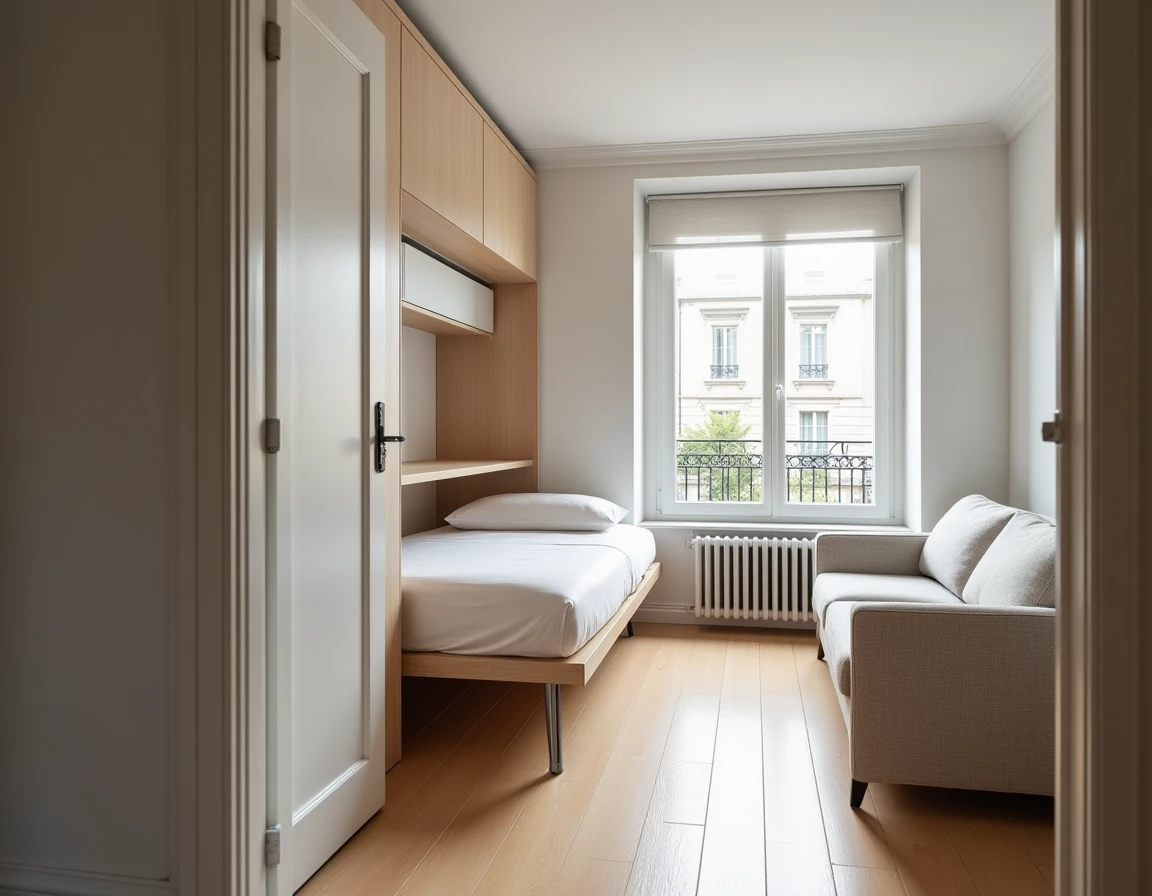
A 9 m² studio meets the legal minimum for habitability, but no one would confuse regulatory compliance with daily comfort. The size of a studio in the city determines the ability to separate functions (sleeping, eating, working), and it is precisely this functional trade-off that guides the choice of an appropriate area.
Functional thresholds of a studio: area and separation of uses

We observe three concrete levels in the layout of an urban studio. Below 14 m², we talk about micro-housing: the space requires foldable furniture, a pull-down bed, and a kitchen reduced to two burners. Storage relies almost entirely on ceiling height.
Between 18 and 22 m², a studio allows for a real sleeping area, a functional kitchen, and a dining space. The separation between the bed and the living room remains visual (screen, curtain, open bookshelf), but it exists.
Beyond 25 m², a studio allows for three distinct zones: sleeping, living, and office. This is the threshold at which remote work becomes realistic without encroaching on the dining area or the bed. To delve deeper into the area of a studio according to Au Comptoir de l’Immobilier, these functional levels are confirmed in most French urban markets.
Ceiling height acts as a multiplier. A 20 m² studio with 3.20 m ceiling height allows for a mezzanine that frees up the entire floor for the living room, kitchen, and office. Without this height, the same area forces functions to be stacked at the same level.
Studio area and rental pressure: what the market dictates

The choice of an area is not made in a vacuum. Local rental pressure sets the relationship between area and rent, and this relationship varies significantly from one city to another.
In tight markets (metropolises, university towns), available studios hover around 20 m², often furnished. In Rennes, recent listings show properties of 20 to 23 m² presented as “perfectly arranged.” In less tight areas, studios of 29 to 30 m² with balconies and parking can be found at comparable rents.
This differential has a direct consequence on comfort. A tenant with the same monthly budget will obtain, depending on the city:
- A 15 m² studio near a campus in a large metropolis, with constrained layout and little storage
- A 23 to 25 m² studio in a medium-sized city, sufficient to separate the sleeping area from the living room
- A 28 to 30 m² studio in a suburban area, sometimes with an outdoor space (balcony, loggia)
We recommend first defining the daily use of the housing (full-time presence, remote work, simple pied-à-terre), then confronting this need with the local market. Searching for a 25 m² in a neighborhood where the supply caps at 18 m² amounts to excluding oneself from the available stock or blowing one’s budget.
Studio layout: the trade-offs that matter per square meter
The layout weighs as much as the gross area. A well-designed 20 m² studio can offer superior comfort compared to a poorly distributed 28 m². Three technical trade-offs deserve particular attention.
Open or closed kitchen
An open kitchen to the main room frees up circulation and visually enlarges the space. In return, smells and noise spread throughout the studio. In a housing unit of less than 22 m², the open kitchen remains the most rational choice, provided one invests in an efficient hood.
Integrated storage and multifunctional furniture
Storage makes the difference between a livable studio and a saturated space. High cabinets, beds with integrated drawers, and foldable tables help keep the floor clear. One linear meter of high cabinet represents a considerable space gain compared to a floor chest of drawers.
The foldable bed (like a wall bed) frees up the entire sleeping space during the day. In an 18 to 20 m² studio, this solution literally transforms the use of the room between day and night.
Bathroom: shower rather than bathtub
An Italian shower takes up less space than a bathtub and facilitates circulation in a small bathroom. In a studio, the bathroom rarely exceeds 3 m²: every decimeter counts.
Studio in the city and remote work: the 25 m² threshold
Remote work has changed the comfort criteria in a studio. Working, sleeping, and cooking in the same single room requires a spatial organization that was not anticipated in the classic plans for small areas.
A fixed desk requires about 2 m² dedicated, which is a surface of 120 x 60 cm with space for a chair. Below 25 m², this space conflicts directly with the dining area or the living room. Alternative solutions (foldable wall-mounted desk, retractable shelf) work for occasional use, but not for a full day of work.
For a studio occupied full-time with regular remote work, we consider that 25 m² is the functional minimum. Below this, the compromise either affects work comfort or living space, and in both cases, the quality of daily life suffers.
- Less than 20 m²: remote work on a folding table, no possible separation between life and work
- From 20 to 24 m²: foldable wall desk, partial separation by a piece of furniture
- 25 m² and more: dedicated fixed desk, clear separation between zones
The area of a comfortable studio in the city is not a single figure. It depends on the actual use of the housing, ceiling height, and the local market. A 20 m² with a mezzanine and good layout surpasses a poorly distributed 28 m². Starting from daily use, then checking what the market offers within the targeted price range, remains the most reliable method to avoid disappointments.